
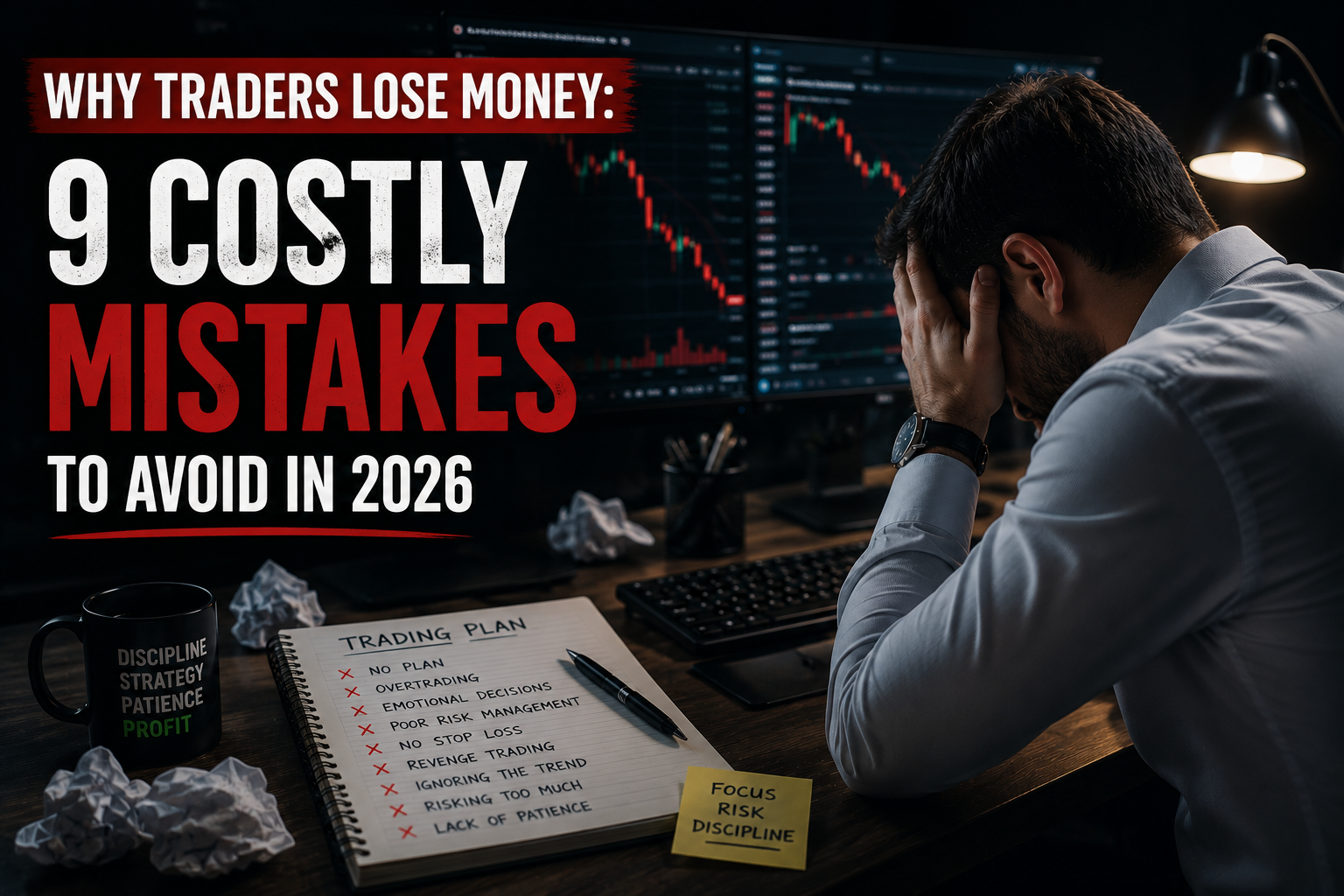
Most traders do not lose because the market is rigged. They lose because their system is not built to survive. Trading looks simple from the outside: buy low, sell high, follow momentum, catch a breakout, use a stop loss, repeat. But real trading is not a chart-reading contest. It is a decision-making contest under uncertainty. The trader is fighting volatility, costs, leverage, slippage, time decay, social media noise, and most importantly, their own impulses.
SEBI reported that 93% of individual traders incurred losses in India’s equity F&O segment between FY22 and FY24, with aggregate losses exceeding ₹1.8 lakh crore. In Australia, ASIC reported that in FY2024, 68% of retail CFD investors lost money, with net losses exceeding A$458 million, including A$73 million in fees.
Meanwhile, U.S. options activity reached record levels in 2025, with OCC reporting 15.2 billion options contracts, up 24.4% from 2024, and Cboe reporting that SPX 0DTE options averaged 2.3 million contracts daily, making up 59% of SPX options volume. That does not mean trading is impossible. It means the average trader enters a professional arena with an amateur process.
This article explains the 9 most costly mistakes traders make in 2026 and how to replace them with a calmer, more disciplined trading mindset.
This article is for educational purposes only. It is not financial, investment, tax, or legal advice. Trading involves risk, and you may lose some or all of your capital.
The Retail Trading Loss Snapshot
| Market / Product | Reported Loss Data | What It Shows |
| India equity F&O, FY22–FY24 | 93% of individual traders lost money; losses exceeded ₹1.8 lakh crore | High activity does not equal profitability |
| Australia CFDs, FY2024 | 68% of retail CFD investors lost money; losses exceeded A$458 million | Leverage and costs can destroy accounts |
| U.S. listed options, 2025 | 15.2 billion options contracts, up 24.4% YoY | Speculative access is expanding |
| SPX 0DTE options, 2025 | 2.3 million contracts daily; 59% of SPX options volume | Very short-term trading is mainstream |
Why Traders Lose Money in 2026
The trading environment in 2026 is different from the old world of slow broker terminals and limited access. Today, a trader can open a mobile app, use margin, trade options, follow a finfluencer, copy a signal group, enter a 0DTE trade, and blow up a week’s salary in minutes.
In the U.S., FINRA has adopted new intraday margin standards that replace the old pattern day trader framework, including the $25,000 minimum equity requirement, with an effective date of June 4, 2026 and an implementation phase-in period through October 20, 2027 for members needing more time. This could increase access for smaller accounts, but access without risk control is not an edge.
The market is not only faster. It is more gamified, more social, more leveraged, and more psychologically demanding. The biggest problem is that most traders focus on entry signals, while professional survival depends on risk, process, emotional control, and repeatability.
Master the Mindset Behind Successful Traders
Get the Trader’s Mindset Mastery Framework Free Now
Get Free GuideMistake 1: Trading Without a Proven Edge
Most beginners ask:
Which stock should I buy?
Which indicator is best?
Where is the next breakout?
What is the best setup for tomorrow?
But professional traders ask:
Does this setup have positive expectancy?
What is the sample size?
What is the average win, average loss, and win rate?
What happens during losing streaks?
Can I execute it consistently?
A trading edge is not a feeling. It is not a screenshot. It is not a guru’s confidence. It is a repeatable condition where, over a large enough sample, the potential reward justifies the risk.
The Expectancy Formula
Expectancy = (Win Rate × Average Win) − (Loss Rate × Average Loss)
Example:
| Metric | Value |
| Win rate | 45% |
| Average win | ₹5,000 |
| Loss rate | 55% |
| Average loss | ₹3,000 |
| Expectancy | ₹600 per trade |
That system can make money even with more losing trades than winning trades.
Now compare this:
| Metric | Value |
| Win rate | 70% |
| Average win | ₹1,000 |
| Loss rate | 30% |
| Average loss | ₹5,000 |
| Expectancy | -₹800 per trade |
That system feels good because it wins often, but it loses money over time.
Why this mistake is costly
Many traders confuse accuracy with profitability. They want a high win rate because it feels emotionally safe. But one large loss can erase many small wins. This is why traders who sell options, average down, or hold losing positions often look successful for weeks—until one event destroys the account.
How to Fix It
| Metric | Why It Matters |
|---|---|
| Win rate | Measures frequency of winning trades |
| Average win | Shows whether winners are meaningful |
| Average loss | Shows whether losers are controlled |
| Risk-reward ratio | Shows whether the trade is worth taking |
| Maximum drawdown | Shows emotional and capital pressure |
| Losing streak | Shows whether the trader can survive normal variance |
| Number of trades tested | Prevents false confidence from small samples |
Mistake 2: Overtrading, Confusing Activity With Progress
Overtrading is one of the most common reasons traders lose money. It usually starts innocently:
- One trade becomes five.
- A small loss becomes a revenge trade.
- A missed move becomes FOMO.
- A profitable morning becomes an overconfident afternoon.
- A boring market becomes a forced setup.
Academic research has repeatedly found that more trading often hurts individual investor performance. Barber and Odean’s famous study of 66,465 brokerage households found that the most active traders earned an annual return of 11.4%, while the market returned 17.9%; the average household earned 16.4% and turned over 75% of its portfolio annually. Their message was blunt: active trading carries a performance penalty.
The Overtrading Trap
More Trades -> More Fees + More Slippage -> More Emotional Decisions -> More Rule Breaking -> Lower Net Returns
Why overtrading feels productive
Overtrading gives the illusion of control. When traders are in a position, they feel like they are working. When they are waiting, they feel like they are missing something. But trading is not paid by the hour. The market does not reward effort. It rewards discipline.
How to Fix It
Create a daily trade limit.
| Account Stage | Max Trades Per Day | Rule |
|---|---|---|
| Beginner | 1–2 | Only A+ setups |
| Intermediate | 2–4 | Stop after two losses |
| Advanced | Strategy-dependent | Based on tested edge |
Mistake 3: Risking Too Much on One Trade
Most traders do not blow up because of one bad entry. They blow up because their position size is too large. A beginner may think:
I’ll risk 10% just this once.
This setup is high conviction.
I’ll make it back quickly.
The stop is too close; I’ll widen it.
This trade cannot fail.
The market only needs one surprise to punish that mindset.
How Drawdowns Become Harder to Recover From
| Loss From Account | Gain Needed to Recover |
| 10% | 11.1% |
| 20% | 25.0% |
| 30% | 42.9% |
| 50% | 100.0% |
| 70% | 233.3% |
A 10% drawdown is manageable. A 50% drawdown requires doubling the remaining capital just to get back to break-even.
The hidden danger
When drawdown gets large, traders become emotionally compromised. They stop thinking in probabilities and start thinking in rescue mode. That is when they:
Convert a trade into a “long-term investment.”
- Increase lot size.
- Remove stops.
- Trade lower-quality setups.
- Chase expiry-day options.
- Borrow money.
- Follow random signals.
- Convert a trade into a “long-term investment.”
How to Fix It
A common professional risk rule is to risk a small, predefined percentage of capital per trade. Many disciplined traders use 0.25% to 2% depending on strategy, volatility, skill, and account size. Example: .
| Account Size | 1% Risk Per Trade | 2% Risk Per Trade |
|---|---|---|
| ₹1,00,000 | ₹1,000 | ₹2,000 |
| ₹5,00,000 | ₹5,000 | ₹10,000 |
| ₹10,00,000 | ₹10,000 | ₹20,000 |
Mistake 4: Misusing Leverage
Leverage is not evil. Professionals use leverage. The problem is that most beginners use leverage before they understand volatility, liquidity, margin, and position sizing.
ASIC describes CFDs as complex, leveraged, over-the-counter products where leverage and financing fees can magnify losses; it also warned that a small adverse price movement can have a big impact, including loss of the entire investment.
The CFTC and NASAA have warned that off-exchange retail forex trading can be extremely risky and, in some cases, connected to fraud. The CFTC also warns that the forex market is volatile, carries substantial risks, and is not a place for money a person cannot afford to lose.
Leverage Magnifies Small Moves
Assume a trader has ₹1,00,000.
| Leverage | Market Move Against Trader | Approx. Account Impact |
| 1× | -2% | -2% |
| 3× | -2% | -6% |
| 5× | -2% | -10% |
| 10× | -2% | -20% |
| 20× | -2% | -40% |
This is before costs, slippage, spread, and emotional mistakes.
Why traders misuse leverage
Leverage appeals to impatience. It promises that a small account can behave like a big account. But leverage does not create skill. It only amplifies the trader’s current skill level. If the trader has poor discipline, leverage accelerates losses.
How to fix it: Framework
Use this leverage checklist before every trade:
| Question | Required Answer |
| Do I know my maximum loss before entry? | Yes |
| Can I survive five losses in a row? | Yes |
| Is this position size based on risk, not greed? | Yes |
| Is the product liquid enough? | Yes |
| Do I understand margin rules? | Yes |
| Am I using leverage to compensate for a small account? | No |
Mindset shift: Leverage should be earned through consistency, not used as a shortcut to escape small capital.
Mistake 5: Chasing 0DTE Options, Expiry Trades, and “Fast Money” Setups
Short-duration products can be useful for experienced traders, hedgers, and institutions.
But for many retail traders, they become a fast path to emotional decision-making. 0DTE options are especially attractive because they offer low upfront cost, fast movement, and dramatic profit screenshots. But the same speed that creates opportunity also creates danger.
Cboe reported that U.S. listed options had a sixth consecutive record year in 2025, with average daily trading of 61 million contracts. It also reported that SPX 0DTE options averaged 2.3 million contracts daily and represented 59% of SPX options volume.
In March 2026, Cboe reported a quarterly SPX 0DTE average daily volume record of 3.0 million contracts and a monthly record of 3.2 million contracts.
The issue is not that 0DTE trading is automatically bad. The issue is that the product leaves very little room for hesitation, poor sizing, late exits, or emotional averaging.
The 0DTE danger cycle
Small Premium -> Large Position Size -> Fast Price Movement -> Emotional Exit or Averaging -> Large Loss
Why traders fall for it
0DTE trading feeds three psychological triggers:
- Urgency: This expires today.
- Lottery payoff: Small money can become big money.
- Social proof: Everyone on X/YouTube/Telegram is trading it.
How to fix it: Framework
Use a product-qualification rule:
| Question | If Answer Is “No” |
| Do I understand Greeks? | Do not trade options |
| Do I understand theta decay? | Do not trade 0DTE |
| Do I know max loss before entry? | Do not enter |
| Have I backtested this setup? | Paper trade first |
| Can I explain why this trade has edge? | Skip it |
Mindset shift: A product being accessible does not mean it is suitable.
Mistake 6: Trading Without a Written Plan
A trader without a plan is not trading. They are reacting. A written trading plan should answer:
- What market do I trade?
- What setup do I trade?
- What time of day do I trade?
- What confirms entry?
- Where is my invalidation point?
- Where is my stop loss?
- Where is my target?
- How much do I risk?
- What makes me skip the trade?
- When do I stop trading for the day?
FINRA warns that day trading requires knowledge of securities markets and brokerage execution systems, and that day trading is generally not appropriate for someone with limited resources, limited experience, or low risk tolerance.
The “No Plan” problem
Without a plan, every candle becomes a signal. Every pullback becomes an opportunity. Every loss becomes negotiable. That creates inconsistency. The trader may use a stop loss on Monday, average down on Tuesday, revenge trade on Wednesday, follow a Telegram signal on Thursday, and blame the market on Friday.
Simple trading plan template
| Plan Component | Example |
| Market | Nifty futures / SPX options / EURUSD |
| Setup | Opening range breakout |
| Time window | First 90 minutes only |
| Entry rule | Breakout with volume confirmation |
| Stop | Below range low |
| Target | 2R or trailing exit |
| Risk | 1% per trade |
| Daily stop | Stop after -2R |
| No-trade condition | Major news in next 30 minutes |
| Review | Screenshot and journal every trade |
How to fix it
Create a one-page plan and keep it visible while trading. Before entering, force yourself to write:
I am entering because ______. My stop is ______. My target is ______. My risk is ______. I will exit if ______.
If you cannot fill those blanks, you do not have a trade.
Mindset shift: A plan does not remove uncertainty. It removes impulsiveness.
Mistake 7: Letting Emotions Control Position Management
The most dangerous trading emotions are not always obvious. Greed is obvious. Fear is obvious. But the more subtle emotions are often more destructive:
- Hope
- Regret
- Ego
- Boredom
- Revenge
- Shame
- Need to be right
Behavioral finance helps explain this. Kahneman and Tversky’s prospect theory found that people evaluate gains and losses relative to a reference point, and that the value function is generally steeper for losses than gains. In simple terms: losses hurt more than equivalent gains feel good.
This is why traders often cut winners too quickly and hold losers too long. Odean’s research on the disposition effect found that investors showed a strong preference for realizing winners rather than losers, and that this behavior was not justified by subsequent performance.
The emotional trading loop
Loss -> Pain -> Need to recover -> Rule breaking -> Bigger loss -> Shame -> More impulsive trading
Common emotional mistakes
| Emotion | Trading Behavior |
| Fear | Exiting winners too early |
| Greed | Oversizing winning streaks |
| Hope | Holding losers beyond stop |
| Ego | Refusing to accept invalidation |
| Revenge | Trading immediately after a loss |
| Boredom | Taking low-quality setups |
| FOMO | Entering after the move is extended |
Traders who struggle with fear, greed, and impulsive decision-making should also understand the importance of emotional control and position management in trading.
How to fix it: Framework
Use emotional circuit breakers:
| Trigger | Rule |
| Two consecutive losses | 30-minute break |
| Daily loss limit hit | Stop trading for the day |
| Trade moved without you | No chase rule |
| Strong urge to recover | Reduce size or stop |
| Anger after exit | Walk away from screen |
Mindset shift: You do not need to eliminate emotion. You need rules that prevent emotion from placing trades.
Control Emotions. Control Results.
Get a proven transformational system for emotional control for consistent trading Performance
Download Free GuideMistake 8: Following Finfluencers, Signal Groups, and “Guaranteed Profit” Claims
The 2026 trader is surrounded by market noise. Every day, social media shows:
- Luxury screenshots.
- Edited profit statements.
- “One setup changed my life” threads.
- Paid signal groups.
- Copy-trading promises.
- Expiry-day option wins.
- “Small account challenge” content.
- Unrealistic daily income claims.
The problem is that most of this content shows outcomes, not process. It shows winning trades, not full trade logs. It shows lifestyle, not drawdown.
The FCA warned in 2025 that some CFD firms were pushing retail clients toward elective professional classification or redirecting them to offshore CFD providers with weaker protections.
The FCA also warned investors to be wary of CFD firms trying to bypass rules and of social media promotions that look too good to be true. The FCA also led international action in April 2026 against illegal finfluencers, with 17 regulators participating in a “week of action.”
Red flags to watch
| Red Flag | Why It Is Dangerous |
| Guaranteed profit | No real trading strategy can guarantee profit |
| No loss strategy | Usually hides tail risk |
| Double your account quickly | Encourages oversizing |
| VIP signal group | Creates dependency |
| Broker link required | Possible conflict of interest |
| Only profit screenshots | No verified long-term record |
| No risk disclosure | Unprofessional and unsafe |
How to fix it
Before trusting any trading educator, ask:
- Do they show losses?
- Do they explain risk?
- Do they teach process or only entries?
- Do they have a verified long-term record?
- Do they disclose conflicts?
- Do they encourage small size?
- Do they tell you when not to trade?
Mindset shift: Do not outsource your judgment to someone who profits from your attention.
Mistake 9: Not Reviewing Trades Like a Professional
Most traders remember their big wins and big losses. Professionals review every trade. A trading journal is not just a diary. It is a performance database. Without a journal, the trader cannot know:
- Which setup works.
- Which time window performs best.
- Which market conditions cause losses.
- Whether losses come from strategy or execution.
- Whether emotions are damaging results.
- Whether the trader is improving.
Weekly review questions
At the end of every week, ask:
- Did I follow my plan?
- Which setups made money?
- Which setups lost money?
- Did I overtrade?
- Did I break my stop?
- Did I move targets emotionally?
- Did I trade during poor conditions?
- What is one rule I must improve next week?
Visualisation 5: The Trader Improvement Loop
Plan -> Execute -> Journal -> Review -> Refine -> Repeat
Most traders stay stuck because they repeat mistakes without measuring them.
Mindset shift: A losing trade can be valuable data. An unreviewed trade is wasted tuition.
The 9 Mistakes
- No proven edge: They trade ideas, not tested probabilities.
- Overtrading: They confuse activity with progress.
- Oversizing: They risk too much on one outcome.
- Misusing leverage: They amplify errors before building skill.
- Chasing 0DTE/expiry trades: They seek speed instead of process.
- No written plan: They react to candles emotionally.
- Poor emotional control: They let fear, greed, and ego manage trades.
- Following finfluencers blindly: They outsource judgment to marketing.
- No review process: They repeat mistakes without learning.
Conclusion: The Market Does Not Reward Excitement. It Rewards Execution.
Most traders do not need more indicators. They need:
- A tested edge.
- Smaller position sizing.
- Fewer trades.
- Better emotional control.
- A written plan.
- A review process.
- Respect for leverage.
- Freedom from social media noise.
- The patience to survive long enough to improve.
The goal is not to predict every move. The goal is to build a process that can survive uncertainty. In 2026, trading access is easier than ever. But easy access does not make trading easy. The traders who last are not the loudest, fastest, or most confident. They are the ones who protect capital, follow rules, learn from data, and master themselves before trying to master the market.
You do not become a better trader by taking more trades. You become a better trader by making fewer mistakes repeatedly.
Leave a Reply