
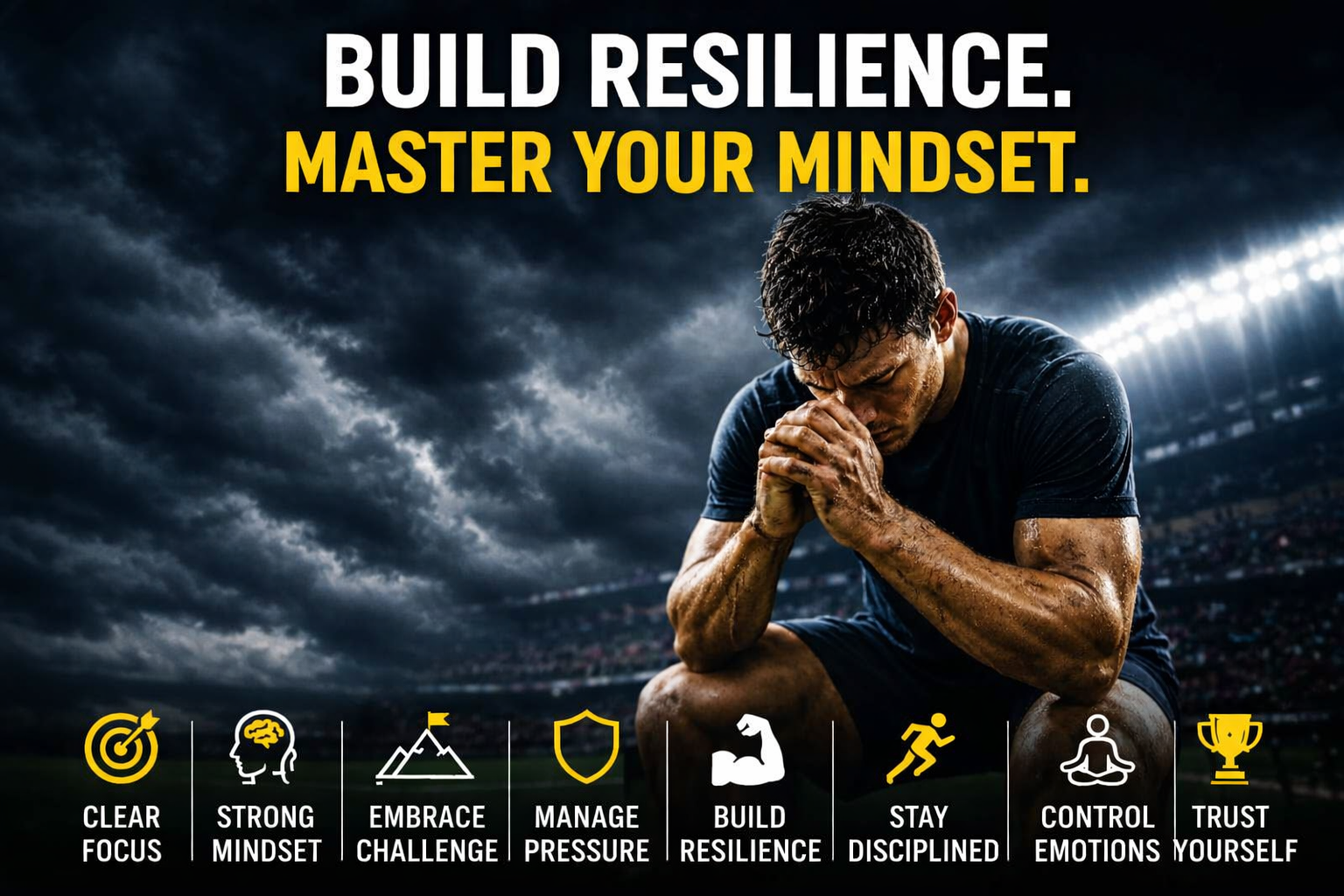
Mental toughness is not about ignoring pain, suppressing emotions, or pretending pressure does not exist. That old version of “toughness” is incomplete, and sometimes dangerous. Modern sport psychology treats mental toughness as a trainable performance skill: the ability to stay focused, emotionally regulated, confident, adaptable, and committed under stress.
The Association for Applied Sport Psychology explains that peak performance is not only about physical fitness; sport and performance psychology helps athletes strengthen their “inner edge,” perform consistently, and thrive.
It includes evidence-based methods such as goal setting, concentration, motivation, relaxation, and imagery. AASP also describes mental strength as a skill that develops through both wins and setbacks, combining emotional control, psychological flexibility, resilience, and the ability to perform under pressure. In other words: mental toughness is not something athletes either “have” or “don’t have.” It is built.
How Do Athletes Build Mental Toughness?
Athletes build mental toughness by training the mind the same way they train the body: repeatedly, deliberately, and under progressive pressure. The most effective methods include pre-performance routines, productive self-talk, visualization, mindfulness, breath control, pressure simulation, process-based goals, recovery habits, and post-performance reflection. The strongest athletes are not fearless. They are trained to act effectively while fear, fatigue, doubt, and pressure are present.
Why Mental Toughness Matters More Than Ever
Today’s athletes face more than competition. They face travel, academic pressure, team selection stress, social media judgment, injury risk, performance expectations, burnout, and the constant pressure to improve.
The NCAA Student-Athlete Health and Wellness Study included more than 23,000 student-athletes across all three divisions. Among women’s sports participants, 44% reported feeling overwhelmed and 35% reported feeling mentally exhausted; among men’s sports participants, 17% reported feeling overwhelmed and 16% reported feeling mentally exhausted. The same NCAA study examined mental health concerns, peer support, sleep behaviors, body image, nutrition, competition, injury history, and substance use, showing how athlete performance is deeply connected to overall well-being.
The International Olympic Committee has also stated that mental health symptoms and disorders are common among elite athletes and may impair performance. That is why a Champion Mindset Program cannot be limited to motivational speeches. It must teach athletes repeatable mental systems.
The Mental Toughness Evidence Scorecard
| Mental Skill | Research Finding | Practical Meaning for Athletes |
| Mental toughness training | Meta-analysis found a large effect, d = 0.80 | Mental toughness can be trained, not just inherited |
| Self-talk | Meta-analysis found a moderate positive effect, ES = .48 | The words athletes repeat under pressure influence execution |
| Imagery | Meta-analysis found a medium effect, d = 0.431 | Mental rehearsal improves motor, motivational, and emotional outcomes |
| Mindfulness training | Meta-analysis found improved performance, SMD = 0.92, and reduced anxiety, SMD = -0.87 | Attention and emotional control are trainable |
| Pre-performance routines | Meta-analysis included 112 effect sizes across sports | Routines help athletes execute under pressure |
| Sleep extension | Stanford basketball players improved free throws by 9% and 3-point shooting by 9.2% | Recovery is a mental toughness multiplier |
Mental Toughness vs. Toxic Toughness
Before we get into the 8 elite secrets, this distinction matters.
Mental toughness says: “I can feel pressure and still execute my next action.”
Toxic toughness says: “I must hide pain, never ask for help, and prove I am strong by suffering silently.”
Mental toughness improves performance and resilience. Toxic toughness increases burnout risk, emotional suppression, and poor decision-making. A truly tough athlete knows when to push, when to reset, when to recover, and when to ask for support. That is not weakness. That is performance intelligence.
The Champion Mindset Flywheel
AWARENESS -> REGULATION -> RESET ROUTINE -> COMMITTED ACTION -> REFLECTION -> RECOVERY -> BETTER AWARENESS
Mental toughness is not a one-time mindset shift. It is a cycle. Athletes notice what is happening, regulate their body and attention, reset quickly, act on the next controllable task, review the lesson, recover, and return stronger.
8 Elite Secrets to Build Mental Toughness in Athletes
Secret 1: Train Attention Before You Train Confidence
Most athletes think confidence comes first. Elite performers know focus comes first. Confidence is unstable when it depends on recent results. Attention is more controllable. An athlete can be nervous and still focus on the next cue. They can feel doubt and still execute the next movement.
They can make a mistake and still return attention to the next play. Sport psychology professionals commonly target concentration, motivation, relaxation, imagery, and goal setting to help performers build consistency.
The Elite Method: The 3-Point Focus System
| Focus Zone | Question | Example |
| Body | What physical cue matters now? | Low hips, Relax shoulders |
| Task | What is the next job? | Track the ball, Hit the target, Win first round |
| Response | How do I react after error or pressure? | Reset, Next rep, Breathe and go |
Athlete Drill: The 10-Second Refocus
After every mistake in practice, the athlete has 10 seconds to complete this reset:
- Exhale.
- Name the mistake without emotion.
- Identify the correction.
- Say one cue word.
- Re-enter the drill.
Example:
“Late reaction. Earlier read. Cue: attack.”
This prevents one mistake from becoming five mistakes.
Secret 2: Build a Pre-Performance Routine That Survives Pressure
A pre-performance routine is a repeatable sequence of thoughts, breaths, cues, and actions an athlete uses before execution. It can be used before a free throw, penalty kick, serve, lift, sprint start, vault, race, pitch, or high-pressure play. Research on pre-performance routines is strong enough that a meta-analysis examined 112 effect sizes across sports, and reporting from the University of Vienna noted that athletes with routines improved from before to after learning and applying them.
Why Routines Work
Pressure creates uncertainty. Routines create familiarity. When the environment becomes chaotic, the athlete’s routine becomes a mental anchor. The athlete does not need to “feel ready.” They simply follow the system.
<
Struggling to create performance routine?
Get Routine Formula for Elite Atheletes
Download Free GuideSecret 3: Replace Negative Self-Talk With Performance Cues
Athletes do not rise to the level of their talent when their internal dialogue is chaotic. Self-talk is not about fake positivity. It is about useful instruction under pressure. A meta-analysis of self-talk and sport performance included 32 studies and 62 effect sizes and found a moderate positive effect on performance, ES = .48.
The 3 Types of Self-Talk Every Athlete Needs
| Type | Purpose | Example |
| Instructional | Directs technique | Elbow high, Quick feet |
| Motivational | Builds effort | Stay with it, Fight for one more |
| Reset | Stops emotional spiral | Next play, Breathe, Back to task |
The Problem With Common Self-Talk
Many athletes use self-talk that is emotional but not actionable:
“Don’t mess up.”
“I can’t lose.”
“I’m choking.”
“Why am I so bad today?”
This gives the brain threat language without a clear action.
Better Self-Talk
“See the target.”
“Win the next step.”
“Long exhale.”
“Trust the rep.”
“Fast hands.”
“Next ball.”
Athlete Drill: Build a Cue Word Bank
Ask the athlete to create cue words for three moments:
| Moment | Cue Word |
| Before performance | Ready |
| During fatigue | Drive |
| After mistake | Reset |
Then practice those cue words during training, not just competition. The mistake many athletes make is waiting until pressure arrives to decide what to say to themselves. Elite athletes script the response before pressure arrives.
Secret 4: Visualize the Response, Not Just the Victory
Most athletes visualize winning. Elite athletes visualize execution. They mentally rehearse the pressure, the obstacle, the mistake, the fatigue, the hostile crowd, the bad call, the missed attempt, and then rehearse their response.
This type of mental rehearsal is a core part of visualization in sports performance and consistency, helping athletes improve confidence, focus, and execution under pressure.
Imagery interventions have strong research support. A meta-analysis found a medium overall effect, d = 0.431, and reported that imagery improved motor performance, motivational outcomes, and affective outcomes.
The 4-Part Elite Visualization Script
SCENE -> PRESSURE -> RESPONSE -> EXECUTION
| Step | What the Athlete Imagines |
| Scene | The real competition environment |
| Pressure | Noise, nerves, fatigue, score, opponent |
| Response | Breath, posture, cue word, focus |
| Execution | The correct action at full speed |
Example: Tennis Player
Instead of visualizing only a perfect ace, the athlete visualizes:
“It is 30–40. My arm feels tight. The opponent is stepping in. I notice the nerves, exhale, bounce the ball, say ‘loose whip,’ and hit a heavy first serve to the body.”
Example: Footballer Taking a Penalty
“The crowd is loud. The goalkeeper is moving. My heart is fast. I exhale, pick my spot, say ‘commit,’ and strike clean through the ball.”
Why This Works
Mental toughness is not built by imagining perfect conditions. It is built by rehearsing effective action in imperfect conditions.
Secret 5: Use Mindfulness to Stop Fighting Pressure
Many athletes make pressure worse because they believe they must eliminate nerves before they can perform. Elite athletes learn something different:
“I can feel pressure and still execute.”Mindfulness helps athletes notice thoughts, emotions, and body sensations without immediately reacting to them. A 2024 meta-analysis found that mindfulness training improved athletes’ performance, mindfulness level, and flow, while reducing psychological anxiety. The study reported large effects for performance SMD = 0.92, flow SMD = 1.47, mindfulness SMD = 1.08, and anxiety reduction SMD = -0.87.
The Elite Method: Name It, Normalize It, Next Action
When an athlete feels pressure: Name it -> Normalize it -> Choose next action
Example:
Name it: “This is nerves.”
Normalize it: “Nerves mean my body is preparing.”
Next action: “Long exhale, eyes on target.”
Athlete Drill: 60-Second Mindfulness Rep
Use before practice or competition:
- 20 seconds: notice breathing.
- 20 seconds: scan body tension.
- 20 seconds: choose one task cue.
No drama. No overthinking. Just awareness and return.
Important Coaching Note
Mindfulness does not make athletes passive. It makes them less reactive. They still compete hard. They still attack. They still push. But they stop wasting energy fighting normal human emotions.
Secret 6: Pressure-Test the Mind in Practice
Athletes do not become mentally tough by staying comfortable in training. They become mentally tough by experiencing controlled discomfort, then learning how to execute through it. This is the missing link in many training programs. Coaches train technique, strength, conditioning, and tactics — but pressure only appears on game day. By then, it is too late.
The Elite Method: Pressure Simulation
Add pressure layers to normal practice:
| Pressure Layer | Example |
| Score pressure | Down by 1 with 30 seconds left |
| Consequence pressure | Miss and the team repeats the drill |
| Fatigue pressure | Execute after a conditioning block |
| Audience pressure | Teammates watch in silence |
| Time pressure | Complete in 10 seconds |
| Distraction pressure | Noise, movement, opponent talk |
| Selection pressure | Best score earns starting role |
Rule: Pressure Must Be Challenging, Not Chaotic
Pressure training should stretch athletes, not humiliate them. The goal is not to break confidence. The goal is to build evidence:
“I have been here before. I know what to do.”
The 3-Level Pressure Progression
Level 1: Skill under mild pressure
Level 2: Skill under fatigue or time demand
Level 3: Skill under competition-like stress
Example for a basketball player:
| Level | Drill |
| Level 1 | Make 7/10 free throws |
| Level 2 | Sprint, then make 7/10 |
| Level 3 | Down 1, crowd noise, teammates watching, must make 2 |
The athlete learns that pressure is not a surprise. It is part of training.
Secret 7: Build Confidence From Evidence, Not Hype
Motivation fades. Hype fades. Confidence based only on praise is fragile. Elite confidence is evidence-based. It comes from completed reps, recovered mistakes, kept promises, preparation logs, and proof that the athlete can handle difficult moments. Mental toughness research supports the link between mental toughness and success.
A sport review found that most studies comparing mental toughness with competitive standard showed mentally tougher athletes participating at higher competition levels, and 77.8% of performance-related studies indicated that mentally tougher athletes tended to achieve more or perform better.
The Confidence Bank
Create a “confidence bank” where athletes deposit proof.
| Deposit Type | Example |
| Preparation proof | Completed all sprint sessions this week |
| Pressure proof | Made 8/10 under consequence |
| Resilience proof | Responded well after mistake |
| Feedback proof | Coach noted better body language |
| Recovery proof | Slept 8.5 hours before match |
Athlete Drill: 3 Proofs Before Competition
Before competition, the athlete writes:
- One proof of preparation.
- One proof of resilience.
- One cue for execution.
Example:
Preparation: I completed 4 high-quality sessions.
Resilience: I reset after errors in practice.
Cue: Fast first step.
This shifts confidence from wishful thinking to evidence.
Secret 8: Recover Like Mental Toughness Depends on It, Because It Does
Recovery is not separate from mental toughness. Recovery fuels it. A tired brain has weaker emotional control, slower reaction time, poorer decision-making, and lower frustration tolerance.
Stanford research on collegiate basketball players found that after sleep extension, players ran faster 282-foot sprints, improved free throw percentage by 9%, improved 3-point percentage by 9.2%, and reported lower fatigue.
A broader review in the British Journal of Sports Medicine states that sleep disruption affects recovery, training, and performance in elite athletes, and that elite athletes often do not get enough sleep.
The Elite Recovery Stack
| Recovery Habit | Why It Builds Mental Toughness |
| Sleep consistency | Improves emotional regulation and reaction time |
| Nutrition and hydration | Stabilizes energy and concentration |
| Active recovery | Reduces physical stress load |
| Breathwork | Downshifts nervous system arousal |
| Reflection journaling | Converts experience into learning |
| Social support | Protects motivation and mental health |
Breathwork Bonus: HRV Biofeedback
Heart rate variability biofeedback research shows that even short daily sessions, 5 minutes twice per day, can improve cardiac autonomic control and anxiety under stress, with some benefits persisting after training stopped.
Simple Recovery Breath Drill
Inhale: 4 seconds
Exhale: 6 seconds
Repeat: 5 minutes
Use it after training, before sleep, or during pre-competition nerves.
The 8 Elite Secrets at a Glance
1. Train Attention
2. Build Routines
3. Script Self-Talk
4. Visualize Pressure Responses
5. Practice Mindfulness
6. Simulate Pressure
7. Build Evidence-Based Confidence
8. Recover Like a Professional
CTA Ebook- The 7-Day Mental Toughness Starter Plan Guide
For Parents: How to Raise Mentally Strong Athletes
Parents play a powerful role in mental toughness. AASP recommends recognizing effort over outcome, normalizing mistakes, encouraging routines, promoting productive self-talk, and letting young athletes take the lead.
The 3 Best Questions After Competition
Instead of starting with “Did you win?” ask:
- What did you do well?
- What did you learn?
- What will you work on next?
These questions create athletes who reflect, adapt, and stay process-focused.
Avoid These Post-Game Mistakes
| Mistake | Better Alternative |
| Immediate criticism | Let emotions settle first |
| Only praising wins | Praise effort, decisions, resilience |
| Comparing to others | Compare to previous version of self |
| Over-coaching in the car | Ask if they want feedback |
| Treating nerves as weakness | Normalize pressure |
Mental Toughness Warning Signs: When Athletes Need More Support
Mental toughness training is not a replacement for mental health care. Athletes may need professional support when they show:
- Persistent anxiety or panic before competition
- Loss of interest in sport
- Sleep disturbance
- Emotional shutdown
- Frequent crying or anger outbursts
- Disordered eating behaviors
- Self-harm thoughts
- Sudden performance collapse with distress
- Fear of talking to coaches or parents
- Burnout symptoms that do not improve with rest
The NCAA found that only about half of student-athletes reported feeling comfortable seeking support from a licensed mental health provider on campus, even though nearly 70% said they had people on campus they could trust for support. A high-performance culture should make help-seeking normal, not shameful.
<
Peak Performance Blueprint – The Foundational Shift
Get A Transformational System for Athletic Excellence
Download Free GuideCommon Myths About Mental Toughness in Athletes
Final Takeaway: Champions Are Built Before the Big Moment
Mental toughness is not created in the final seconds of a match. It is built in the daily routine: the breath after a mistake, the cue word during fatigue, the journal after a poor performance, the visualization before competition, the recovery choice at night, and the courage to keep training the mind when nobody is watching.
The champion athlete is not the one who never feels pressure. The champion athlete is the one who has trained what to do when pressure arrives.
Leave a Reply