
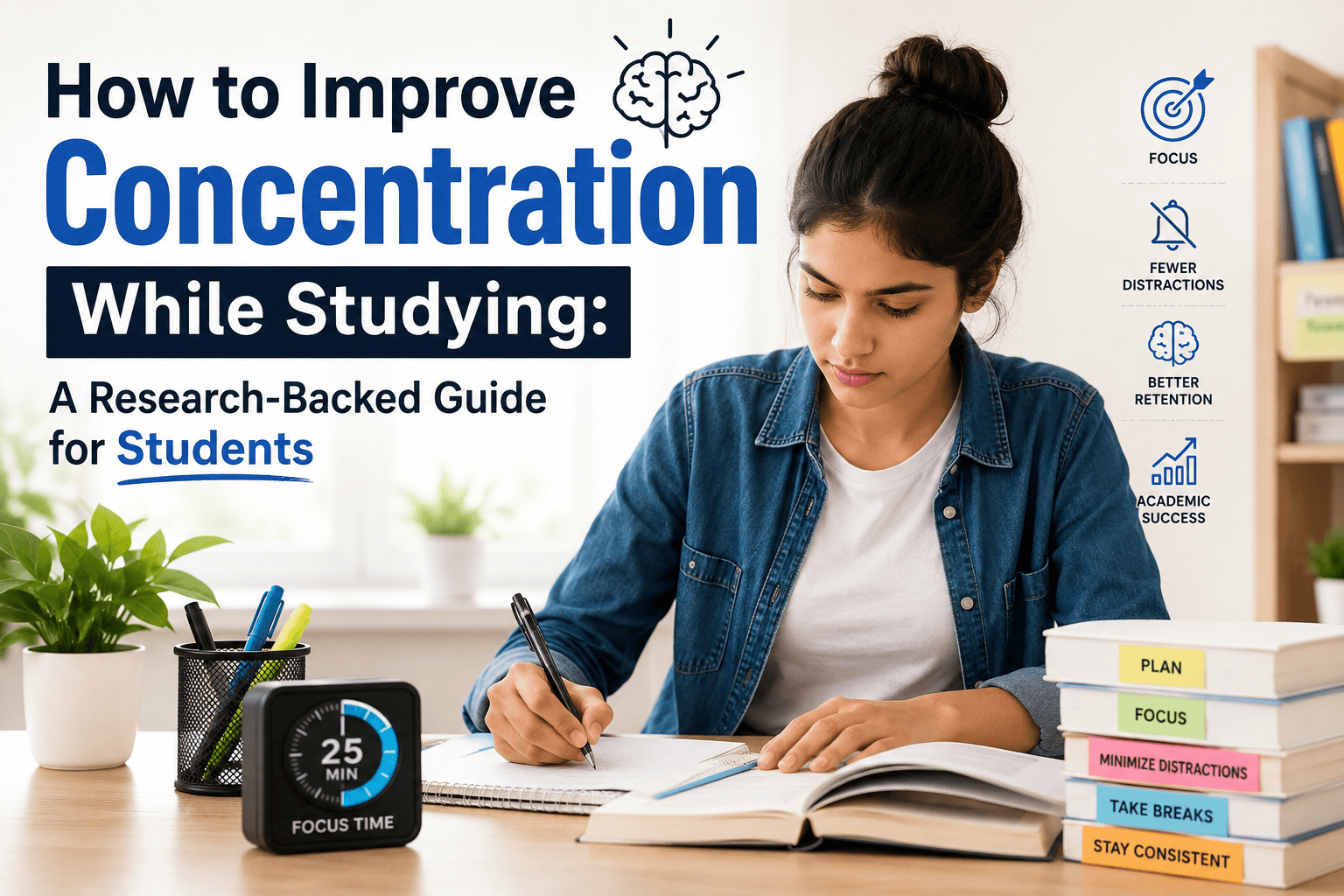
Many students think concentration is something they either “have” or “do not have.” They sit with their books open, read the same paragraph five times, check their phone, feel guilty, restart, get distracted again, and finally conclude: “I just cannot focus.” But poor concentration does not always mean laziness, lack of intelligence, or weak motivation. Often, it means the student is using the wrong study system.The modern student is not only fighting difficult subjects. They are fighting notifications, social media, sleep loss, academic pressure, multitasking, stress, and passive study habits that make the brain feel busy without creating deep learning. CDC clearly states that proper sleep helps students stay focused, improve concentration, and improve academic performance. Research on media multitasking also shows that multitasking during learning can negatively affect academic outcomes. So the question is not simply, “How do I study longer?” The better question is: “How do I design my brain, body, environment, and study method so focus becomes easier?”
What Is Concentration While Studying?
Concentration is the ability to direct your attention toward one learning task and keep it there long enough to understand, remember, and apply information. For students, concentration includes four skills:
| Concentration Skill | What It Means |
| Starting focus | Sitting down and beginning the task without delay |
| Sustained focus | Staying with the task without constant switching |
| Selective focus | Ignoring distractions like phone, noise, or random thoughts |
| Recovery focus | Returning to study after losing attention |
Most students do not need perfect focus. They need better recovery focus. A focused student is not someone who never gets distracted. A focused student is someone who notices distraction and returns quickly.
Why Students Struggle to Concentrate While Studying
The Main Causes of Poor Study Focus
| Cause | How It Shows Up | What To Fix |
| Phone distraction | Checking notifications every few minutes | Use phone distance and app blocking |
| Passive study | Reading without testing yourself | Use active recall |
| Vague goals | “I will study biology” | Set measurable targets |
| Mental fatigue | Mind wanders after 20–30 minutes | Use focus blocks and breaks |
| Sleep loss | Heavy eyes, slow thinking | Protect sleep routine |
| Stress | Racing thoughts and worry | Use breathing and brain dump |
| No structure | Random topic switching | Use a study plan |
| Physical inactivity | Restlessness or low mood | Add short movement breaks |
Why Concentration Needs a Serious Strategy
| Research-backed finding | Why it matters for students |
| Sleep helps students stay focused, improve concentration, and improve academic performance. | Sleep is part of studying, not separate from studying. |
| Media multitasking during learning can negatively affect academic outcomes. | Studying with phone and social media open reduces learning quality. |
| APA notes that switching between complex tasks takes a toll on productivity. | Multitasking is usually fast task-switching, not true focus. |
| CDC says physical activity has brain-health benefits for school-aged children, including improved cognition, academic performance, and memory. | Movement supports focus, not just fitness. |
| WHO reports that 80% of adolescents do not meet recommended physical activity levels. | Many students are missing a natural focus booster. |
| Dunlosky and colleagues found practice testing and distributed practice among the most useful study techniques. | Better study methods improve concentration because they keep the brain active. |
The Big Myth: “I Need Motivation Before I Can Focus”
Most students wait to feel motivated before studying. But motivation often comes after action, not before it. A student may not feel focused at 5:00 pm. But if they sit down, remove their phone, open one chapter, set a 25-minute timer, and solve five questions, focus may begin after 5–10 minutes. The first goal is not to feel inspired. The first goal is to start cleanly.
15 Science-Backed Ways to Improve Concentration While Studying
1. Start With a Clear Study Target, Not a Vague Intention
Use the 3-Part Study Target
Every study session should have:
| Element | Example |
| Topic | Human respiration |
| Task | Draw diagram and answer 15 questions |
| Time | 45 minutes |
Example
Instead of: “I need to study physics.”
Use: “For the next 40 minutes, I will solve 12 numericals from Newton’s Laws and mark every mistake.”
This reduces mental friction and helps students begin faster.
2. Remove the Phone From the Study Zone
The phone is one of the biggest concentration killers because it offers unlimited novelty. Research has repeatedly linked media multitasking with weaker attention and academic outcomes. The American Academy of Pediatrics review notes that multitasking with media during learning, whether in class or at home, can negatively affect academic outcomes. Stanford researchers have also reported a correlation between media multitasking, poor attention, and memory problems.
Student Script
“I am not avoiding my phone forever. I am only creating one protected focus block.”
This makes phone control feel manageable.
3. Use Active Recall Instead of Passive Rereading
Passive study destroys concentration because the brain is not forced to work. A student can read a page while thinking about something else. But they cannot answer a question from memory without paying attention. That is why active recall is one of the most powerful concentration tools. Dunlosky and colleagues reviewed 10 common learning techniques and found strong support for practice testing and distributed practice. The Learning Scientists also recommend retrieval practice at the end of spaced study sessions.
Passive Study vs Active Study
| Passive Study | Active Study |
| Rereading notes | Closing notes and writing what you remember |
| Highlighting paragraphs | Answering questions without looking |
| Watching lectures only | Pausing and explaining aloud |
| Copying notes | Solving problems |
| Reading formulas | Writing formulas from memory |
4. Study in Focus Blocks, Not Endless Marathons
Many students try to study for 4–5 hours continuously. Then they lose focus, feel guilty, and assume they are weak. The brain works better with structured effort and recovery. A focus block is a planned period of deep study followed by a short break.
Which Block Should Students Choose?
| Student Type | Recommended Block |
| Easily distracted | 25 + 5 |
| Moderate focus | 40 + 10 |
| Strong focus | 50 + 10 |
| Exam revision | 45 + 10 |
| Problem-solving subject | 50 + 10 |
The goal is not to study endlessly. The goal is to study deliberately.
5. Use the “One Tab, One Book, One Task” Rule
Many students study with:
- Three tabs open
- YouTube lecture running
- WhatsApp Web active
- Notes app open
- Textbook open
- Random PDFs open
- Music changing every few minutes
This creates cognitive overload. APA explains that doing more than one complex task at a time takes a toll on productivity.
6. Create a Dedicated Study Environment
The brain links places with behaviors. If the bed is used for sleeping, scrolling, snacking, and studying, the brain gets confused. If a table is consistently used for studying, the brain starts entering study mode faster.
The Ideal Study Space
| Study Space Element | Why It Helps |
| Clean desk | Reduces visual distraction |
| Good lighting | Prevents sleepiness and eye strain |
| Comfortable chair | Helps longer attention |
| Water nearby | Prevents unnecessary breaks |
| Required books only | Reduces switching |
| Phone away | Protects focus |
| Timer visible | Creates urgency |
A student should not need 20 minutes to “settle down.” The environment should make starting easy.
7. Use Spaced Practice to Avoid Mental Overload
Students lose concentration when they try to learn too much too late. Cramming creates stress and fatigue. Spaced practice creates repeated exposure over time. The Learning Scientists explain that spaced practice is the opposite of cramming: instead of studying for one long period close to the exam, students spread learning across a longer period, producing more long-lasting learning.
Why Spacing Improves Concentration
Spacing helps because:
- Study sessions feel smaller.
- The brain gets recovery time.
- Revision becomes less stressful.
- Memory strengthens through repeated recall.
- Students avoid last-minute panic.
Simple Spacing Schedule
| Day | Task |
| Day 1 | Learn topic |
| Day 2 | Recall without notes |
| Day 4 | Practice questions |
| Day 7 | Mixed quiz |
| Day 14 | Mock test or summary |
Concentration improves when the student is not fighting panic.
8. Use Movement Breaks to Reset the Brain
Sitting for long hours does not guarantee learning. The body and brain are connected. Movement can improve alertness, mood, and cognitive readiness. CDC states that physical activity has brain-health benefits for school-aged children, including improved cognition, academic performance, memory, and reduced symptoms of depression. WHO also notes that physical activity in children and adolescents supports motor and cognitive development.
Movement Break Ideas
| Time Available | Movement |
| 1 minute | Stand, stretch, roll shoulders |
| 3 minutes | Walk around the room |
| 5 minutes | Stairs, squats, skipping, brisk walk |
| 10 minutes | Outdoor walk |
| 20 minutes | Light sport, cycling, yoga |
The break should refresh attention, not become a 45-minute scrolling session.
9. Protect Sleep Like a Study Strategy
A sleepy student cannot concentrate well, no matter how motivated they are. CDC states that adequate sleep contributes to student health and helps students stay focused, improve concentration, and improve academic performance. CDC also notes that children and adolescents who do not get enough sleep are more likely to have attention and behavior problems that can contribute to poor academic performance.
Night-Before-Exam Routine
| Time | Activity |
| Early evening | Final active recall |
| After dinner | Light review |
| 30 minutes before bed | Pack materials |
| 15 minutes before bed | Write worries/checklist |
| Bedtime | No phone, slow breathing |
Students should not treat sleep as leftover time. Sleep is part of memory training.
10. Use a Brain Dump When Thoughts Keep Interrupting
Many students lose concentration because of mental clutter. A brain dump helps remove these thoughts from working memory.
Brain Dump Method
Keep a “distraction page” beside you. Whenever a thought interrupts, write it down instead of following it.
| Interrupting Thought | Write It Down As |
| “Check phone” | Check phone after study block |
| “I may fail” | Worry, review after session |
| “Need to revise chapter 6” | Add to tomorrow’s plan |
| “Hungry” | Break snack after timer |
| “I forgot homework” | Add to checklist |
Rule
Capture the thought. Do not obey it immediately. This lets the brain relax because the thought is not lost, but it is not controlling the session.
11. Use Breathing to Calm Study Anxiety
Sometimes poor concentration is not a study problem. It is an anxiety problem. When students feel pressure, the body becomes tense. The heart beats faster. Breathing becomes shallow. The mind starts jumping. APA notes that stress affects multiple body systems, including the nervous, cardiovascular, respiratory, and muscular systems. Mindfulness meditation has also been linked by psychologists with positive changes in brain and biology, improving mental and physical health.
Study Anxiety Reset Script
“I do not need to finish everything right now. I only need to complete this focus block.”
This shifts the brain from panic to action.
12. Study With Questions, Not Just Notes
Questions create attention. When the brain is looking for an answer, it focuses better. Before reading a topic, create 3–5 questions.
Question-Based Study Template
| Before Study | During Study | After Study |
| Write questions | Search for answers | Recall answers |
| Predict exam topics | Mark key points | Solve questions |
| Identify confusion | Ask why/how | Explain aloud |
This turns reading into investigation.
13. Use Interleaving for Subjects That Become Boring
Some students lose focus because they study the same type of problem for too long. Interleaving means mixing related problem types instead of doing only one type repeatedly. This keeps the brain active because it has to identify which method to use.
When To Use Interleaving
| Good For | Example |
| Maths | Mixed problem sets |
| Physics | Mixed numericals |
| Chemistry | Reaction identification |
| Grammar | Mixed error correction |
| Economics | Mixed case questions |
Interleaving may feel harder, but that difficulty often creates stronger learning.
14. Hydrate and Eat for Stable Energy
A dehydrated or hungry student will struggle to concentrate. Research reviews suggest that even mild dehydration can impair cognitive performance, and water supplementation may improve fatigue, short-term memory, attention, and reaction. This does not mean students need complicated diets. They need stable energy.
Study-Friendly Nutrition Basics
| Problem | Better Option |
| Sugary snacks only | Fruit, nuts, curd, eggs, sprouts, sandwich |
| No water for hours | Keep water bottle on desk |
| Heavy oily meal before study | Lighter meal before focus block |
| Too much caffeine | Limit caffeine, avoid late evening |
| Studying hungry | Small snack before session |
The brain cannot focus well if the body is uncomfortable.
15. End Every Study Session With an Error Log
Many students lose focus because they do not see progress. An error log creates visible improvement. Instead of thinking:
“I studied for two hours.”
The student can say: “I found 6 weak areas and fixed 3 of them.”
Error Log Template
| Question/Topic | Mistake Type | Correct Method | Review Date |
| Trigonometry Q5 | Formula confusion | Revise identities | Friday |
| Photosynthesis | Missing diagram label | Redraw from memory | Tomorrow |
| History answer | Weak structure | Use intro-body-conclusion | Sunday |
| Physics numerical | Unit error | Check units before final answer | Wednesday |
An error log improves concentration because each study session has a purpose: find, fix, and repeat.
Struggling to Focus? Download This Free Guide
The Mastery Blueprint Concentration Model
Get Free Guide
The Best Study Routine to Improve Concentration
The 90-Minute Mastery Blueprint Study Block
| 5 minutes | Set goal and clear desk |
| 25 minutes | Learn/revise concept |
| 5 minutes | Break, stretch, water |
| 25 minutes | Active recall/practice questions |
| 5 minutes | Break |
| 20 minutes | Error correction and summary |
| 5 minutes | Plan next session |
Why This Works
| Part | Purpose |
| Goal setting | Reduces confusion |
| Focus block | Builds attention |
| Break | Prevents fatigue |
| Active recall | Forces real concentration |
| Error correction | Creates visible progress |
| Next-step plan | Reduces tomorrow’s friction |
Subject-Wise Concentration Strategies
For Mathematics
Avoid only watching solution videos.
Focus Task Example
“Solve 15 problems from quadratic equations. Mark mistakes as formula, step, or calculation errors.”
For Science
Focus Task Example
“Draw the human heart diagram from memory and label it without looking.”
For History or Social Studies
Focus Task Example
“Create a timeline of the freedom movement and write 5 causes of the event without notes.”
For Languages
Focus Task Example
“Write one essay introduction, two body paragraphs, and one conclusion in 35 minutes.”
For Commerce/Economics
Focus Task Example
“Explain demand elasticity with one definition, one formula, one graph, and one real-life example.”
The Concentration Killers Students Should Avoid
| Concentration Killer | Why It Hurts Focus | Better Alternative |
| Studying with phone nearby | Creates constant attention switching | Keep phone outside room |
| Rereading for hours | Low mental engagement | Use active recall |
| Studying on bed | Brain associates bed with rest | Use desk or table |
| No study target | Creates confusion | Set topic + task + time |
| All-night study | Damages focus and memory | Sleep-protected revision |
| Too many resources | Causes overwhelm | Use one main resource |
| Comparing with friends | Creates anxiety | Track personal progress |
| Long study marathons | Leads to fatigue | Use focus blocks |
| Ignoring mistakes | Repeats errors | Maintain error log |
How Parents Can Help Students Improve Concentration
Better support looks like:
| Instead of Saying | Say This |
| “Study for 5 hours.” | “What is your first 40-minute study target?” |
| “Why are you using your phone?” | “Let us keep your phone away for one focus block.” |
| “You never concentrate.” | “Let us make your study desk easier to focus on.” |
| “You should know this already.” | “Which part needs active recall practice?” |
| “Don’t take breaks.” | “Take a planned break and return on time.” |
Parents should focus on structure, not shame.
How Teachers Can Help Students Build Focus
Teachers can improve student concentration by:
- Teaching students how to study, not just what to study.
- Using low-stakes quizzes.
- Giving retrieval practice questions.
- Encouraging error logs.
- Explaining how to revise.
- Reducing unnecessary ambiguity.
- Providing sample answer formats.
- Teaching students to break large tasks into smaller ones.
The Learning Scientists identify spacing, retrieval practice, elaboration, interleaving, concrete examples, and dual coding as effective learning strategies. These methods help students stay mentally active instead of passively copying or rereading.
When Poor Concentration Needs Extra Support
Sometimes poor concentration is not just a study habit issue. Students may need support from a parent, teacher, counselor, psychologist, or doctor if they experience:
- Constant inability to focus across all subjects
- Severe anxiety or panic
- Sleep problems for many nights
- Very low mood
- Frequent headaches or fatigue
- Sudden drop in academic performance
- Extreme restlessness
- Difficulty completing normal daily tasks
- Attention problems that have been present for years
Support is not a failure. It is a way to understand the real cause and build the right solution.
Conclusion
Students do not improve concentration by simply saying:
“From tomorrow, I will focus.”
They improve concentration by designing better conditions:
- Clear study goals
- Phone-free focus blocks
- Active recall
- Spaced revision
- Short breaks
- Movement
- Sleep
- Hydration
- Error correction
- Calm routines
The goal is not to become a robot who studies for 10 hours without distraction. The goal is to become a student who knows how to start, stay focused, recover from distraction, and study in a way that actually builds memory and performance. That is the promise of the Academic Performance—Mastery Blueprint Program: helping students turn scattered effort into focused, confident, high-performance learning.
“Concentration is not about forcing your brain to study harder. It is about designing your study system so your brain has fewer reasons to escape.”
Leave a Reply