
Every exam season, millions of capable students experience the same frustrating pattern:
- They study hard.
- They understand the chapter at home.
- They solve questions during practice.
- Then the exam paper arrives, and suddenly their mind goes blank.
The heart races. Hands sweat. Thoughts spiral: What if I fail? What if I disappoint my parents? What if everyone else finishes before me? The student is no longer just answering questions. They are fighting a mental battle while trying to retrieve information under pressure. That is exam anxiety.
A moderate amount of nervous energy can sharpen focus, but excessive test anxiety can interfere with attention, memory, confidence, and execution.
Test anxiety has been reported in roughly 10% to 41% of school-aged children, with estimates of 15% to 20% among college students in prior research summaries. This matters because anxiety is not just an emotional issue; it is an academic performance issue. A meta-analysis cited in a systematic review found a negative association between test anxiety and academic performance, and worry tends to be more strongly related to lower performance than physical anxiety symptoms alone.
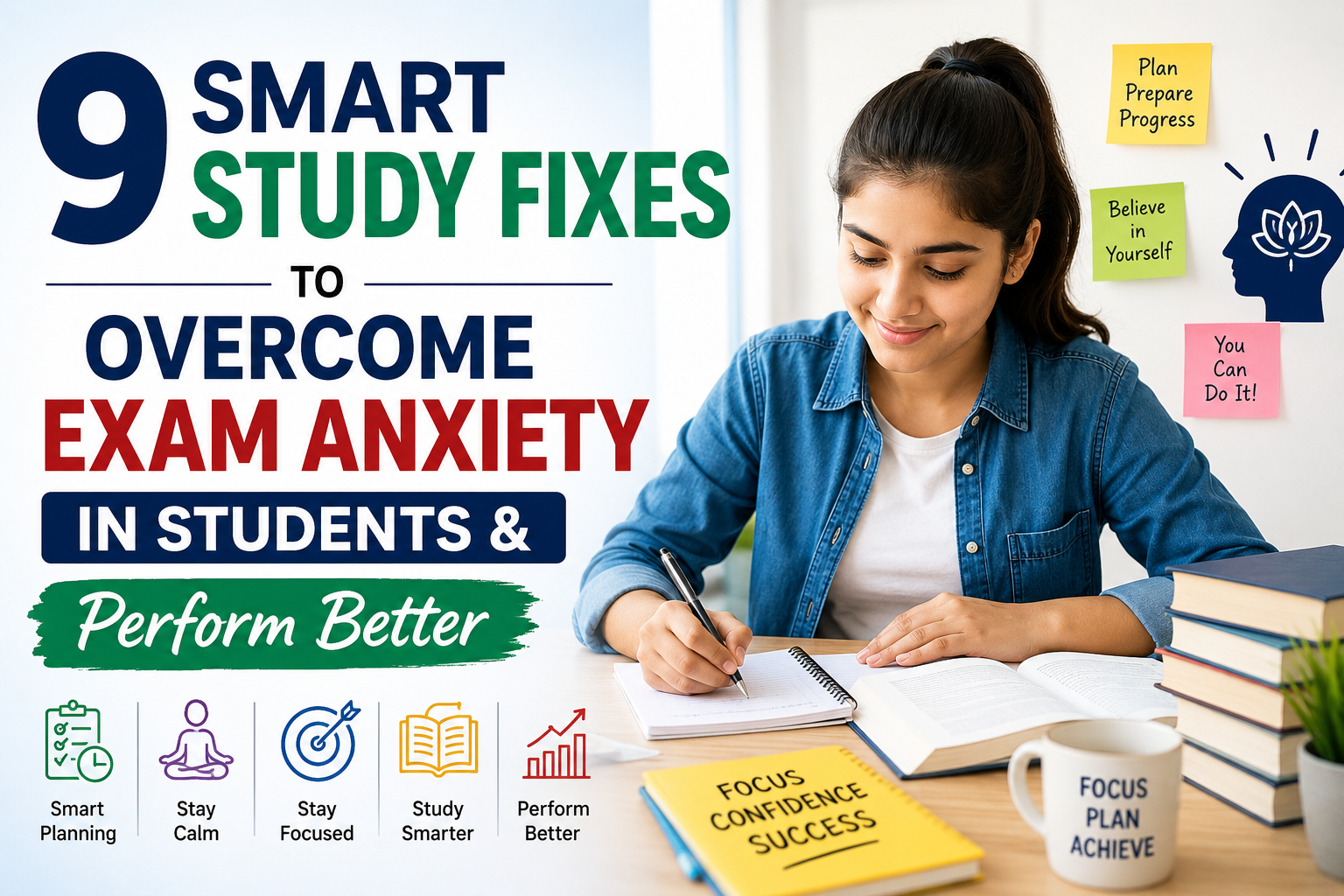
The good news: exam anxiety is trainable. Students do not need vague advice like “just relax” or “study harder.” They need a smarter study and performance system. This guide explains 9 smart study fixes students can use to reduce exam anxiety, study more effectively, and perform closer to their true ability.
The Exam Anxiety Loop: Why Smart Students Underperform
Exam anxiety usually works like a loop.
Pressure to perform -> What if I fail? thoughts -> Physical anxiety: racing heart, tension, sweating -> Poor concentration and memory retrieval -> Mistakes, blanking out, slow recall -> Lower confidence -> More pressure before the next exam
The problem is not that the student has “no potential.” The problem is that their study system and nervous system are not trained for pressure. Exam success is a combination of four skills:
| Performance Pillar | What Students Learn |
| Calm Body | Control physical anxiety before and during exams |
| Clear Mind | Stop worry loops and negative self-talk |
| Smart Study | Use memory-based learning methods instead of passive rereading |
| Exam Execution | Manage time, questions, mistakes, and pressure inside the exam hall |
Why Exam Anxiety Needs a Serious Strategy
| Research-backed insight | Why it matters for students |
| CDC data show that adolescent mental health concerns remain high; in 2023, 40% of U.S. high school students reported persistent feelings of sadness or hopelessness. | Academic stress often overlaps with broader emotional distress |
| Children and teens who do not get enough sleep have higher risk of poor mental health and attention or behavior problems | All-night studying can damage the exact focus students need for exams |
| AASM recommends 9–12 hours of sleep for ages 6–12 and 8–10 hours for ages 13–18 | Sleep is part of preparation, not a reward after preparation |
| CDC recommends children and adolescents aged 6–17 get at least 60 minutes of moderate-to-vigorous physical activity daily | Movement supports cognition, memory, mood, and stress regulation |
| Dunlosky and colleagues reviewed 10 learning techniques and highlighted practice testing and distributed practice as especially useful strategies | Students should replace passive rereading with active recall and spacing |
Get yourself out from anxiety loop.
Get a Transformational System for Clarity, Confidence, and Academic Excellence
Download Free GuideThe Study Method Upgrade
LOW-RETURN STUDY HABITS
Highlighting -> Rereading -> Last-minute cramming -> Panic revision
HIGH-RETURN STUDY HABITS
Spaced practice -> Retrieval practice -> Mock exams -> Error correction -> Calm execution
9 Smart Study Fixes to Overcome Exam Anxiety and Perform Better
The 9 Smart Study Fixes
1. Map anxiety triggers
2. Space study sessions
3. Practice retrieval, not rereading
4. Train with mock exams
5. Write out worries
6. Reframe anxiety as energy
7. Protect sleep
8. Move daily
9. Follow an exam-day operating system
Fix 1: Create an Anxiety Map Before Creating a Study Plan
Most students say, “I am stressed about exams.” That is too broad to solve. A better first step is to identify the exact anxiety trigger. Exam anxiety usually comes from one or more of these sources:
| Anxiety Trigger | Example Thought | Smart Fix |
| Preparation anxiety | I have too much syllabus left | Break syllabus into daily retrieval blocks |
| Performance anxiety | I know it, but I blank out in exams | Use timed mock tests and pressure practice |
| Evaluation anxiety | What will my parents or teachers think? | Reframe results as feedback, not identity |
| Time anxiety | I will not finish the paper | Train with exam timing and question sequencing |
| Memory anxiety | I keep forgetting everything | Use active recall, spaced repetition, and error logs |
Student Exercise: The 3-Column Anxiety Map
Ask the student to write:
| Situation | Fear Thought | Action I Can Train |
| Math test starts | I will forget formulas | 10-minute formula retrieval daily |
| Long-answer questions | I will run out of time | Practice 3 timed answers per week |
| Night before exam | I have not done enough | Night before the exam |
This turns anxiety into a training plan. Anxiety feels overwhelming when it is vague. Once it becomes specific, the student can act on it.
Fix 2: Stop Cramming. Use Spaced Study Blocks Instead.
Cramming feels productive because it creates short-term familiarity. But familiarity is not the same as exam-ready memory. Spaced practice means spreading learning across time instead of packing everything into one long session.
The Learning Scientists explain that students usually retain more when they study in smaller sessions across several days rather than in one large block.
Visual: Cramming vs Spacing
Cramming Pattern
Day 1: nothing
Day 2: nothing
Day 3: nothing
Day 4: nothing
Day 5: 6 hours panic study
Spaced Pattern
Day 1: 45 min
Day 2: 45 min
Day 3: 45 min
Day 4: 45 min
Day 5: 45 min review + test
[CTA – 14day anti anxiety study plan]
Fix 3: Replace Passive Rereading With Retrieval Practice
Many anxious students reread the same notes again and again because it feels safe. But rereading often creates the illusion of mastery. Retrieval practice means closing the book and pulling information from memory.
Dunlosky and colleagues reviewed multiple study techniques and identified practice testing as one of the strongest learning strategies across ages, materials, and outcome types.
What Retrieval Practice Looks Like
Instead of asking: “Did I read this chapter?” Ask: “Can I explain this chapter without looking?”
Instead of: “Did I highlight the formula?” Ask: “Can I write the formula from memory and use it in a problem?”
Retrieval Practice Menu
| Subject Type | Retrieval Method |
| Science | Draw diagrams from memory, explain processes aloud |
| Math | Solve without examples, write formulas from memory |
| History | Create timelines without notes |
| Languages | Recall grammar rules, write sample answers |
| Business/Economics | Explain concepts using real examples |
| Law/Theory | Write issue-rule-application-conclusion outlines |
The 5-Minute Brain Dump
At the start of each study session:
- Take a blank sheet.
- Write everything remembered about the topic.
- Open notes and compare.
- Mark missing ideas.
- Study only the gaps.
This method reduces anxiety because students stop guessing whether they know something. They test it.
Fix 4: Practice Under Exam Conditions Before the Exam
A student who only studies in relaxed conditions may panic in timed conditions. The exam hall has different pressure:
- Limited time
- Silent room
- No notes
- Unpredictable questions
- Marks attached to performance
- Fear of comparison
If the first time a student experiences that pressure is the actual exam, anxiety will spike.
The Solution: Pressure Practice
Use mock tests as emotional training, not just academic testing.
| Practice Type | Purpose |
| Untimed practice | Build understanding |
| Timed section practice | Build speed |
| Full mock test | Build stamina |
| Difficult-question practice | Build resilience |
| Error review | Build accuracy |
Mock Test Rule
After every mock test, students should divide mistakes into four categories:
| Mistake Type | Meaning | Fix |
| Knowledge gap | Did not know the concept | Relearn topic |
| Memory gap | Knew it but forgot | Retrieval practice |
| Process error | Wrong steps or careless mistake | Slow down and checklist |
| Anxiety error | Panicked or rushed | Breathing + question sequencing |
This changes mock exams from confidence killers into confidence builders.
Fix 5: Use a 10-Minute Worry Dump Before High-Pressure Tests
One of the most practical exam anxiety tools is expressive writing. In a University of Chicago study published in Science, students who wrote about their worries before an important test improved performance, especially students prone to test anxiety.
The university summary reports that anxious students improved high-stakes test scores by nearly one grade point after 10 minutes of writing about what caused fear.
A later randomized controlled trial in Chinese senior-high-school students also found that expressive writing focused on positive emotions helped reduce test anxiety over time.
The 10-Minute Worry Dump Script
Before a mock test or real exam, write:
I am worried that…
The worst thought in my mind is…
The feeling in my body is…
This exam matters because…
One thing I can control right now is…
The first step I will take is…
Then close the notebook. The goal is not to magically eliminate anxiety. The goal is to reduce mental clutter so working memory is available for the exam. Students struggling with repetitive worry patterns can also learn practical strategies to stop overthinking before exams.
When to Use It
- Night before the exam
- Morning of the exam
- 10 minutes before a mock test
- After a panic-heavy study session
Fix 6: Reframe Anxiety Signals as Readiness Signals
Many students interpret a racing heart as proof that something is wrong. But in many performance situations, physical arousal is the body preparing for action. A classroom study on stress reappraisal found that students taught to view stress arousal as potentially useful reported less math evaluation anxiety and showed improved exam performance compared with controls.
Old Interpretation
“My heart is racing. I am going to fail.”
New Interpretation
“My body is giving me energy. I can use this to focus.”
This is called cognitive reappraisal: changing the meaning of a sensation or thought.
The 30-Second Reappraisal Script
Before the paper starts, silently repeat:
“This feeling is energy. My body is preparing me to perform. I do not need to remove anxiety. I need to use it.”
Add Breathing to Calm the Body
The APA recommends self-calming strategies such as deep breathing for students experiencing anxiety. Use this simple breathing pattern:
Inhale for 4 seconds
Exhale for 6 seconds
Repeat 5 times
Longer exhalation helps shift the body away from panic mode and gives the student a sense of control.
Fix 7: Protect Sleep Like It Is a Study Subject
Sleep is not wasted study time. Sleep is when the brain consolidates memory. CDC notes that children and adolescents who do not get enough sleep have higher risk of poor mental health and attention or behavior problems.
The American Academy of Sleep Medicine recommends 9–12 hours per 24 hours for ages 6–12 and 8–10 hours for ages 13–18.
Why All-Nighters Backfire
All-night study may increase exposure to content, but it can reduce:
- Attention
- Working memory
- Emotional control
- Problem-solving speed
- Recall accuracy
For anxious students, sleep loss is especially costly because tired brains are more reactive and less flexible.
The Sleep-Protected Revision Rule
The night before the exam:
| Time | Action |
| 6:00–7:30 pm | Final active recall |
| 7:30–8:00 pm | Dinner and break |
| 8:00–8:45 pm | Formula/key-point review |
| 8:45–9:00 pm | Pack exam materials |
| 9:00–9:20 pm | Worry dump |
| 9:20 pm onward | No new topics, wind down |
Exam Week Sleep Checklist
☐ Same wake-up time daily
☐ No phone in bed
☐ No new chapter late at night
☐ Final revision ends before sleep routine
☐ Bag, ID, pens, calculator packed early
☐ Morning alarm set
Fix 8: Move Daily to Reduce Stress and Improve Brain Readiness
A still body often creates a restless mind. CDC states that school-aged youth should do 60 minutes or more of physical activity daily, and notes that physical activity has brain-health benefits including improved cognition, memory, academic performance, and reduced symptoms of depression.
WHO also reports that 81% of adolescents aged 11–17 were physically inactive globally, meaning they did not meet WHO guidelines.
Visual: Movement and Exam Readiness
Daily movement -> Lower physical tension -> Better mood and alertness -> Improved focus during study -> Better sleep quality -> Stronger exam performance
Student-Friendly Movement Plan
| Situation | Movement Fix |
| Before study | 5-minute walk or stretching |
| During long study | 3-minute movement break every 45–60 minutes |
| Before mock test | 10 jumping jacks or brisk walk |
| Night anxiety | Gentle stretching, not intense exercise |
| Exam morning | Light walk, deep breathing |
Movement should not become another pressure goal. It should be used as a nervous-system reset.
Fix 9: Build an Exam-Day Operating System
Many students prepare for the syllabus but not for the exam experience. An exam-day system reduces panic because the student already knows what to do.
The Exam-Day System
Step 1: Arrive With a Prepared Body
Sleep -> breakfast -> water -> materials -> calm breathing
Avoid last-minute panic conversations with highly stressed classmates.
Step 2: Scan the Paper First
Spend the first 2–3 minutes scanning:
- Easy questions
- Medium questions
- Time-consuming questions
- Questions with high marks
- Sections with choices
This gives the brain a map.
Step 3: Start With a Confidence Question
Do not start with the hardest question unless required. Answering one familiar question early builds momentum and tells the nervous system, I can do this.
Step 4: Use the “Skip and Return” Rule
If stuck for more than 60–90 seconds: Mark it -> move on -> return later. Getting trapped in one question increases panic and wastes marks.
Step 5: Use a Panic Reset
When anxiety spikes:
Pause
Feet flat on floor
Inhale 4
Exhale 6
Relax shoulders
Read the question again
Underline command words
Start with the first step
Step 6: End With a Review Routine
Use the final minutes to check:
☐ Did I answer all required questions?
☐ Did I label diagrams?
☐ Did I show steps in math?
☐ Did I include units?
☐ Did I check silly mistakes?
☐ Did I write roll number/details correctly?
Common Exam Anxiety Mistakes Students Should Avoid
| Mistake | Why It Increases Anxiety | Better Alternative |
| Studying only by rereading | Feels familiar but may not build recall | Test yourself without notes |
| Starting revision too late | Creates panic and overload | Use spaced study plan |
| Avoiding difficult topics | Anxiety grows through avoidance | Break hard topics into micro-practice |
| Taking mock tests too late | No time to fix errors | Start small timed tests early |
| Sleeping less to study more | Reduces focus and emotional control | Protect sleep as memory work |
| Comparing with classmates | Triggers fear and self-doubt | Track personal progress |
| Trying to feel zero anxiety | Unrealistic goal | Learn to perform with manageable anxiety |
The Parent and Teacher Role: Reduce Pressure, Increase Structure
Students do better when adults provide structure without emotional threat.
- Instead of saying: “You must get top marks.”
Say: “Let us focus on today’s study block and review what improved.”
- Instead of: “Why are you so nervous?”
Say: “Your body is reacting to pressure. Let us use the breathing routine and start with one question.”
- Instead of: “You studied this already. How did you forget?”
Say: “Forgetting shows us what to retrieve again.”
CDC emphasizes that school staff and families can create protective relationships and help students grow into healthy adults.
When Exam Anxiety Needs Extra Support
Study fixes are powerful, but some students need professional help. Consider speaking with a school counselor, psychologist, or qualified mental-health professional if a student experiences:
- Panic attacks before or during exams
- Frequent crying or shutdowns
- Avoiding school or tests
- Sleep disruption for many nights
- Loss of appetite
- Self-harm thoughts
- Anxiety that affects daily functioning
- Extreme fear of disappointing others
- Physical symptoms that feel unmanageable
Intervention research suggests that cognitive, behavioral, relaxation, skill-focused, and multimodal approaches can reduce test anxiety, and CBT plus breathing exercises appear especially useful when delivered through longer programs for younger students.
Stop anxiety before it starts.
The Mastery Blueprint: A Weekly Anti-Anxiety Study System
Download Free GuideFinal Takeaway: Confidence Comes From Evidence
Students do not become confident because someone tells them, “Be confident.” They become confident when they have evidence:
I tested myself.
I fixed errors.
I practiced under time.
I handled anxiety before.
I slept enough.
I know my exam strategy.
Exam anxiety is not solved by pressure. It is solved by preparation, self-regulation, and repeated proof that the student can handle challenge. The goal is not to eliminate every nervous feeling.
The goal is to help students walk into the exam with a trained mind, a calmer body, and a reliable performance system. That is the heart of our Academic Performance—Mastery Blueprint Program: helping students study smarter, manage pressure better, and perform closer to their true potential.
“Exam confidence is not a feeling you wait for. It is evidence you build through smart practice, calm routines, and repeated retrieval.”
Leave a Reply